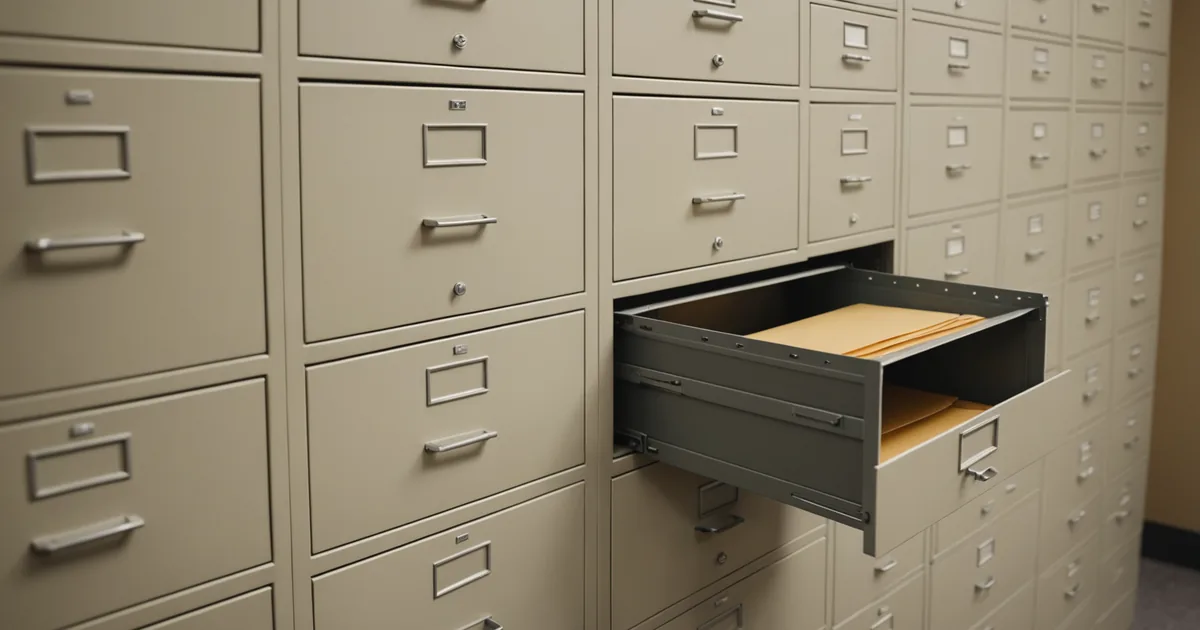
County permit archives were scanned to preserve the documents, not to make them searchable. That distinction matters for anyone building an extraction pipeline over them. The scanning decisions made during a preservation project, typically funded once and executed over months or years, determine what is retrievable from the resulting PDFs and what is not.
Understanding those decisions requires understanding why county scanning projects were undertaken in the first place and under what constraints they operated.
Why County Archives Were Scanned
Most county permit archive scanning projects were driven by two concerns: physical deterioration of paper records and storage space reduction. Paper files degrade. Older permit folders, especially those from the 1960s and 1970s, were on paper stock that yellows and becomes brittle. Microfilm copies, where they existed, required specialized readers that departments were trying to phase out. Scanning produced a preservation copy that was readable without special equipment and could be stored digitally rather than in filing cabinets.
The goal was faithful image capture for long-term retention. It was not to produce documents optimized for optical character recognition or field extraction. These are different technical requirements, and a scanning project designed for preservation often makes tradeoffs that are neutral for preservation but costly for extraction.
Scan Resolution and Its Consequences
Scan resolution is expressed in dots per inch (DPI). Higher DPI produces a larger file but a more detailed image. The threshold for reliable OCR on printed government forms is generally considered to be 300 DPI. Many county preservation projects scanned at 200 DPI or 150 DPI because lower resolution reduced file storage requirements, which mattered when the scanning projects were designed and storage was more expensive.
At 200 DPI, standard printed text on a permit form is readable, but character shapes are less defined than at 300 DPI. Small type, condensed fonts, and characters with similar shapes (0 and O, 1 and l, 5 and S in some typefaces) become harder to distinguish. A permit number printed in 8-point condensed type at 200 DPI may produce an OCR confidence score well below what a 300 DPI scan of the same text would produce.
At 150 DPI, which appears in some batch scanning projects from the early 2000s, small text is frequently unreliable for OCR. APN fields, permit numbers, and date fields printed at standard government form sizes are at the edge of what is tractable.
This is not a failure of the current extraction pipeline. It is a constraint set by scanning decisions made fifteen to twenty years ago. The extraction pipeline works with whatever image quality the archive provides.
What a Permit File Typically Contains
A physical county permit file folder often contains more than the permit application form. The file accumulates documents over the life of the permit: the original application, the review comments from each department, the issued permit card, any amendments or revisions, inspection records filed chronologically, and the final close-out documentation.
When this folder was scanned, several things may have happened:
The entire folder was scanned in order, producing a multi-page PDF where the application form is on page one and subsequent documents appear in chronological order. This is the best case for extraction, because the document types are identifiable by position and the key fields (APN, permit number, issue date) appear early.
The folder was scanned in the order papers happened to be in the folder, which may not be chronological. A 2003 amendment appears on page two, the original 1999 application appears on page six. An extraction pipeline needs to identify document type before extracting fields, not assume page order.
The folder was scanned but some pages were missed, folded, or placed face-down. Page gaps are not always detectable without reading the content. A missing close-out certificate in the middle of a permit file is not distinguishable from a permit that was never officially closed.
Duplex Scanning and Shadow Artifacts
Double-sided documents create specific problems when scanned without proper duplex handling. If a two-sided permit application was placed in a flatbed scanner and only one side was captured, the second side is absent from the PDF. If it was scanned in a sheet-fed scanner with duplex enabled but the back side was blank, the blank page may or may not appear in the PDF depending on how the scanner handled blank-page suppression.
The more common artifact from two-sided documents is show-through: text from the reverse side of a thin paper document bleeding through as a ghost image on the scanned page. On a permit application where printed text on the reverse appears as faint reversed characters behind the front-side text, OCR attempts to read both layers simultaneously. The resulting character confusion can corrupt field values on otherwise clean pages.
Show-through is particularly common in older documents on thinner paper stock. A building permit from the early 1980s may be on paper that would be classified as tissue-weight by modern standards. Show-through severity on these documents can render some text fields effectively unreadable by OCR.
Documents That Were Not Scanned
Archive scanning projects typically had defined scope. Large-format documents, including site plans, architectural drawings, and survey plats attached to permit applications, were often excluded because standard flatbed and sheet-fed scanners cannot handle E-size drawings. These documents may have been separately microfilmed, stored in a plan room, or simply left in the physical folder when the permit file was scanned.
An APN or parcel identification on a site plan attached to a permit application would not be present in the PDF if the site plan was not scanned. This is not an extraction failure. The data was never captured in a form the pipeline can access.
Some counties also excluded certain document types from scanning based on records retention schedules. A routine inspection record with a short retention period might have been scheduled for destruction rather than preservation, and would therefore not appear in the archive regardless of how comprehensive the scanning project was.
Indexing at Scan Time
When a batch of permit files was scanned, the resulting PDFs were indexed in the document management system. The indexing was typically done by a scanning operator who entered a few fields: document type, address or APN, scan date. The quality of this indexing determines how reliably the archive can be searched.
Indexing errors at scan time are common. An operator scanning several hundred documents in a day may transpose digits in an APN or enter "123 Main St" when the document says "123 Main Street NW." These indexing errors persist in the archive. A search for the correct APN returns no results because the PDF was indexed under a transposed version.
For an extraction pipeline, indexing errors at the archive level affect discoverability before extraction begins. A document that cannot be found in the archive because it was indexed under an incorrect identifier is effectively absent from the extraction pass unless the pipeline searches by document content rather than by archive index.
What This Means for Realistic Coverage Expectations
A realistic assessment of what an extraction pipeline can produce from a county permit archive has to start with what the archive actually contains. The archive is not a complete, cleanly indexed set of every permit and violation ever issued. It is a preservation copy of most of the files that existed when the scanning project was executed, captured at whatever resolution and with whatever completeness the project budget allowed.
The extraction pipeline works on what is there. High-quality scans of complete documents produce high-confidence extractions. Low-resolution scans, documents with show-through, pages with stamp overlays, and files where some pages are missing produce lower-confidence extractions or no-extract outcomes.
The value of extraction is not that it produces a perfect record set. It is that it surfaces the substantial portion of the archive that is extractable, and explicitly identifies what remains in the unextracted or low-confidence tier. That explicit accounting is more useful than the current state, where the archive is not queryable at all and no tier distinction exists.